
Kirstenbosch National Botanical Garden


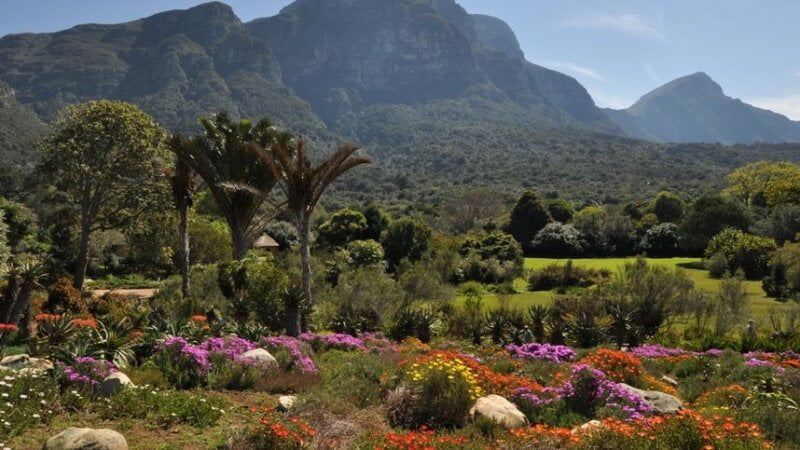


Two clans lived on the Cape Peninsula, the Gorachouqua and the Goringhaiqua. They grazed their cattle in Table Valley in early summer, travelled to the Hout Bay area in midsummer and crossed the Cape Flats to the Boland during winter. In April 1652 Jan Van Riebeeck, acting for the Dutch East India Company, arrived at the Cape to set up a refreshment station for passing ships. The settlement soon spread to our side of TableMountain in search of timber and farmland.
On 27 October 1657 a stretch of forest that included Kirstenbosch was granted to Leendert Cornelissen, a free carpenter and sawyer. At that time, this land was known as Leendertsbos. Cornelissen was responsible for protecting the forest from indiscriminate hacking for firewood in order to provide a steady supply of wood for the settlement. The settlement lay in the path of traditional Khoikhoi grazing routes and open conflict broke out between the Khoikhoi and the settlers during 1659-60. Kirstenbosch lay on the frontier and Cornelissen and his men were involved in a skirmish with a group of Khoikhoi people in the forest in May 1659.
Jan Van Riebeeck decided that a defensive barrier was required to protect the settlement. In 1659 they started building a wooden fence, with watchtowers, from the mouth of the Salt River through Rondebosch to Kirstenbosch, using the deeper sections of the Liesbeeck River as part of the barrier. But the fence was expensive, and slow-going. In 1660 Van Riebeeck ploughed up and planted the remaining section between the river and Kirstenbosch with a hedge of Wild Almond trees (Brabejum stellatifolium) and thorny brambles. Sections of Van Riebeeck’s Hedge still survive in Kirstenbosch.
By 1661 Leendert Cornelissen was discharged from his office as a Burgher Councillor for brawling, fighting and swearing, and little is heard of him after 1672 when Leendertsbos reverted to the Company. During the time that the forests were being harvested, the woodcutters made tracks through the forest where timber was hauled out, some of them are still in use as footpaths or access roads. All that remains of the woodcutter’s house is a few piles of stones and a line of stones across the Stinkwood Trail.